Do we have an AI token cost solution in sight?
In 2026, AI token cost has become a growing concern in boardrooms across the world.
As a solution, one approach that is getting more attention is model routing - sending each AI task to the model that makes the most sense for that particular task.
Why use an expensive frontier model for a routine task when a much cheaper model can do the job?
Routine, lower-complexity tasks can potentially be routed to open-weight models including models originating from China where pricing can be 5x–25x lower than comparable frontier models.
There is another interesting advantage.
Organizations can run these Chinese open-weight models on their own infrastructure or access them through routing platforms such as OpenRouter. This can potentially give organizations more control over data residency, compliance and governance than directly sending sensitive workloads to an externally hosted Chinese model - which has been a major concern for organizations worldwide.
And the change in adoption numbers is quite remarkable.
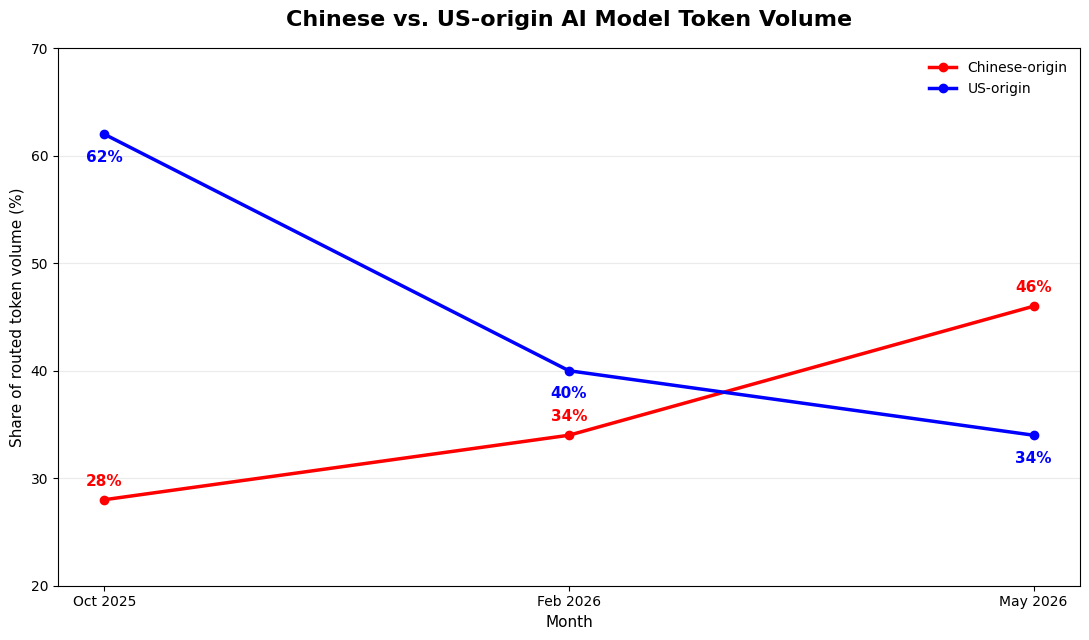
Recently released data from OpenRouter indicates that Chinese-origin open-weight models accounted for approximately 46% of routed token volume in May 2026, compared with approximately 34% for US-origin models.
Compare that with October 2025 Chinese-origin at ~28% vs. US-origin at ~62%
That's a significant shift in just a few months.
But there are some important caveats
OpenRouter is not the whole market. It is a proxy for model-routing activity, with a developer heavy and API-centric user base.
More token volume doesn't necessarily mean more valuable workloads. Chinese-origin models could simply be handling a larger share of routine or lower complexity tasks.
Still, the direction is interesting.
As Chinese models continue to improve, the competition may not remain only about cost and volume. It could increasingly become about capability as well.
Hopefully, over the coming quarters, the boardroom's concern about AI token cost will shift to something else and that would be a good problem to have.